
Data types
- Four data types
- Each datatype has its own set of underlying assumptions about how numerical symbols correspond to real-worl observations
Nominal data type
- Numbers indicate categories
- Order is not meaningful
Example : Religious affiliation (catholic, jewish, muslim...)
Ordinal data type
- Order in the numbers is important
- Intervals between numbers are not fixed
- Calculations are meaningless
Example : Pain scales
Interval data type
- Order in the numbers is important
- Intervals between numbers are fixed
- Arbitrary zero point
- Basic calculations possible (+ & -)
Example : Temperature scale, IQ scale
Ratio data type
- Order in the numbers is important
- Intervals between numbers are fixed
- Fixed, meaningful zero point
- All calculations possible (+ & -, * & /)
Example : Age, Height, Weight, Time
Data types
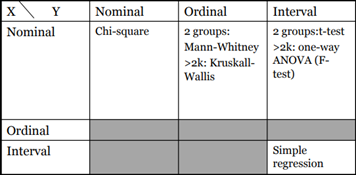
- Data types determine which statistical technique you can choose to analyze your data
- Example : You want to study the influence of X on Y
null
Exam questions : Data types
"Being bored" is defined as the number of times someone yawns. What's the data type of this measurement ?
- Interval
Which of the following measurement provides data of an ordinal data type ?
- The number of ducks in the lake
- The types of bird in the lake
- The grams of bread eaten by a duck
- None of the above
- Types of bird
Data types
- From interval/ratio to lower data type : no proble
- However, you lose information
- Ages from 1-100 reduced to categories "young" "middle aged" "old" (ordinal)
- From lower level to higher data type : not possible !
- Therefore : try to use as "high" a data type as possible when creating measurement scales
Symmetric scale : Treat as interval (no reason to assume intervals are not equal)
Asymmetric scale : Treat as ordinal (interval size cannot be estimated properly)
WRAP UP : Data types :
- The way you formulate your questions and answers scales affects the usefulness of the data you collect
- Use as high a data type as you reasonably can
- Carefully consider how the data types you choose affect your statistical analysis